

FOR HIGH ROLLERS

 Fabian Raemy
Quick Answer: On November 12, 2025, President Trump signed P.L. 119-37 into law. Buried inside a government spending bill was Section 781, which fundamentally rewrote the federal definition of hemp to count THCa toward the 0.3% THC threshold and not just Delta-9. A second rule caps finished hemp products at 0.4 milligrams of total THC per container. Neither restriction takes effect until November 12, 2026, meaning products on shelves today remain legal. But the clock is running, and the law is already reshaping the industry.
Disclaimer: The information in this article reflects the state of federal hemp law as of April 2026. We will update this article as the legislative situation changes, but given how quickly this area of law is moving, we recommend checking official government sources like Congress.gov for the most current status of any legislation mentioned here.
If you’ve bought THCa flower, vapes, or hemp-derived cannabinoids at any point in the last few years, you’ve probably been following the news around the so-called “federal hemp ban” with some combination of confusion and concern.
The terminology being thrown around, Schedule I, loophole, and federal enforcement, sounds alarming without context. And most of the coverage landing in your feed either oversimplifies the law into a scare headline or buries the relevant details in legal language that assumes you have a JD.
The reality is more specific and more nuanced than either extreme suggests. This isn’t a sudden prohibition with overnight enforcement. It’s a statutory redefinition with a one-year grace period, active legislative pushback in Congress, and real uncertainty about what the industry looks like on the other side.
What it means for you as a buyer right now depends on your state, the brands you buy from, and how the next several months play out on Capitol Hill.
Here’s the full picture.
To make sense of what’s being taken away, you need to know how it was granted in the first place. The Agriculture Improvement Act of 2018, commonly called the 2018 Farm Bill, removed hemp from the federal definition of marijuana under the Controlled Substances Act. The key clause was simple: hemp was defined as Cannabis sativa L. with a Delta-9 THC concentration of no more than 0.3% on a dry-weight basis.
That word “Delta-9” turned out to be enormously consequential.
THCa is the raw, unheated form of THC. It exists naturally in the cannabis plant before any heat is applied, and in that raw state, it doesn’t produce psychoactive effects on its own. When you apply heat, by lighting flower or hitting a vape, a process called decarboxylation converts THCa into Delta-9 THC, which is what actually gets you high. That conversion happens at the moment of consumption.
The 2018 Farm Bill only counted Delta-9 THC at harvest and testing time. THCa, chemically distinct in its raw form, wasn’t included in the threshold. A cannabis plant with 25% THCa and only trace Delta-9 could legally qualify as hemp because it tested under 0.3% Delta-9 at the time of the lab test. The fact that smoking that same plant would deliver a full Delta-9 THC experience was irrelevant under the statutory definition.
That’s not a hidden secret. It’s how THCa flower works and why the market for it exploded after 2018. THCa products were a legal way to access the same functional experience as conventional cannabis in states where adult-use remained prohibited.
By 2025, the intoxicating hemp sector was valued at approximately $28.4 billion, supported an estimated 300,000 jobs, and generated roughly $1.5 billion in state tax revenue, according to Frier Levitt’s March 2026 federal hemp analysis.
Federal agencies weren’t happy with this arrangement for years. The DEA and FDA both issued guidance suggesting that high-THCa products should be treated as controlled substances rather than legal hemp.
The more visible pressure came from a coalition of 39 state attorneys general, who sent a formal letter to Congress arguing that state-level regulation of intoxicating hemp was effectively impossible given how freely these products moved across state lines.
Products with 20–30% THCa were being sold in gas stations and convenience stores, online without age verification, and in markets where conventional cannabis remained entirely illegal.
That gave Congress a credible public health justification to act. They did, but they just waited until a must-pass spending bill gave them the legislative vehicle to do it without a standalone debate.
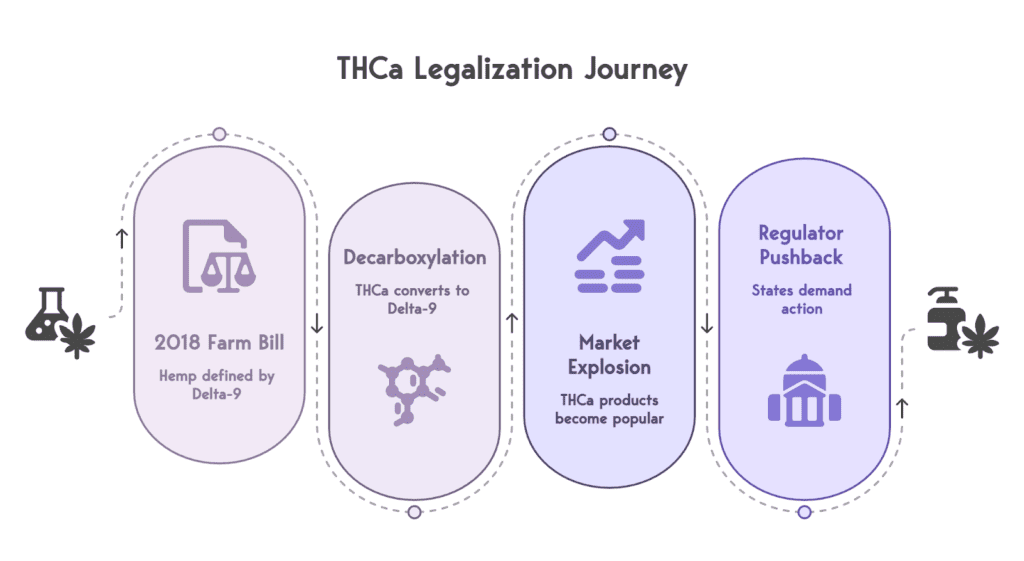
The provision that changed everything is called Section 781 of P.L. 119-37, passed as part of the Continuing Appropriations, Agriculture, Legislative Branch, Military Construction and Veterans Affairs, and Extensions Act, 2026.
President Trump signed it on November 12, 2025. According to the Congressional Research Service’s analysis of the law, Section 781 makes three principal changes to the existing hemp framework.
Hemp is now redefined as Cannabis sativa L. with a total THC concentration of no more than 0.3% on a dry-weight basis. Total THC explicitly includes THCa and Delta-8 THC, and both count toward that ceiling, together. The prior definition only counted Delta-9.
For context: THCa flower routinely tests at 20–30% THCa. Under the new definition, that flower would register total THC far above the 0.3% threshold and would no longer qualify as hemp.
It would instead be reclassified as marijuana, a Schedule I controlled substance, under the Controlled Substances Act. Perkins Coie’s legal update on the legislation notes that these changes take effect 365 days after enactment, putting the enforcement date at November 12, 2026.
Synthetic cannabinoids are also explicitly excluded. Cannabinoids like Delta-8 THC, which are typically produced by chemically converting CBD through a process called isomerization rather than being extracted directly from the plant, are banned outright under the new definition. Regardless of their Delta-9 content. HHC falls into the same category.
This is the part of the law that most buyers haven’t heard about, and it’s arguably more sweeping than the dry-weight change. In addition to the 0.3% total THC threshold for raw hemp, Section 781 imposes a hard limit of 0.4 milligrams of total THC per container for any finished hemp-derived cannabinoid product intended for human use.
To put that in perspective, current market products typically contain 2.5 to 10 milligrams of Delta-9 THC per unit. The new limit is 6 to 25 times lower than what’s on shelves today.
DLA Piper’s analysis of the new restrictions points out that this threshold is low enough to capture a broad range of non-intoxicating wellness products, including full-spectrum CBD tinctures and similar formulations, not just psychoactive products. The U.S. Hemp Roundtable has estimated that 90% or more of existing hemp-derived cannabinoid products would fall outside the new definition.
“Container” means the innermost packaging for retail sale, such as a bottle, bag, cartridge, or can. The FDA was mandated to publish a clearer regulatory definition of the term, along with three lists of covered cannabinoids, by February 10, 2026.
That deadline passed without the agency delivering any of the required guidance. Marijuana Moment reported on February 18, 2026 that the FDA simply did not follow through, drawing sharp criticism from industry groups who have been waiting on compliance clarity for months.
As of April 2026, that guidance still has not been published, which means the scope of what counts as a compliant “container” remains legally undefined heading into the enforcement window.
The law does preserve a carve-out for industrial hemp grown for non-cannabinoid uses. Fiber, grain, seed oil, microgreens, and research applications are explicitly protected. The ban is aimed at consumable cannabinoid products specifically.
| Product Type | Legal Now (Pre-Nov. 12, 2026) | Status After Nov. 12, 2026 |
| THCa Flower | Yes | No, fails total THC threshold |
| THCa Vape Carts | Yes | No, exceeds 0.4 mg/container |
| Delta-8 Products | Yes | No, synthetic exclusion |
| HHC Products | Yes | No, synthetic exclusion |
| Full-Spectrum CBD | Yes | Mostly No, 0.4 mg limit |
| Industrial Hemp (fiber, grain) | Yes | Yes, preserved carve-out |
Nothing in this table has changed yet. Every product category listed as “Yes” today remains legal for buyers through November 12, 2026.
The hemp provisions in P.L. 119-37 were slipped into a must-pass government funding bill, which meant there was no standalone floor debate, no committee markup specifically on hemp, and very limited time for industry response before the bill passed.
Senator Rand Paul moved to strip the hemp language by emergency amendment on the Senate floor. The motion was tabled 76 to 24. The provision survived.
What followed was an immediate legislative counter-effort that’s still ongoing.
Three pieces of legislation represent the main industry response as of early 2026, per Frier Levitt’s March 2026 legislative roundup:
The 2026 Farm Bill adds another layer of complexity. House Agriculture Committee Chairman Glenn Thompson filed an 802-page draft of the Farm, Food, and National Security Act of 2026 in February 2026.
While the draft addresses relief for industrial hemp producers, it does not directly engage the consumable product ban. Thompson’s stated position is that finished goods regulation falls outside the Agriculture Committee’s jurisdiction, belonging instead with the House Committee on Energy and Commerce.
The House Agriculture Committee voted 34 to 17 to advance the 2026 Farm Bill on March 5, 2026, without any provision to delay or modify the hemp product ban. As of April 2026, no repeal or delay bill has cleared Congress. The November 12, 2026, enforcement date remains the law of the land.
Most of the coverage around this issue is aimed at businesses, manufacturers, retailers, and farmers, because they’re the ones facing existential decisions about product lines, supply chains, and capital. For buyers, the practical picture is simpler, though it depends on where you live.
The enforcement date is November 12, 2026. THCa flower, vapes, prerolls, and other hemp-derived products remain fully legal at the federal level for the duration of this grace period. Buying them now carries no federal legal exposure for consumers. The risk falls on the producer and retailer side if no legislative relief passes before November.
What changes closer to Q3 and Q4 2026 is product availability. If no repeal or delay legislation passes, brands will need to either reformulate products to meet the 0.4 mg container limit, pivot their entire product line, or exit certain categories. Buyers in markets that depend on the DTC hemp channel for access should pay attention to how that situation develops.
Some states haven’t waited for the federal clock. Ohio enacted Senate Bill 56 in December 2025, imposing a categorical state-level ban on intoxicating hemp products. New Jersey advanced legislation requiring accelerated liquidation of non-compliant inventory and routing THC beverages into its licensed cannabis framework after November 2026. Minnesota’s existing model, per-serving THC limits, age-gating, and mandatory labeling, has been cited by federal legislators as evidence that workable state regulation is possible without outright prohibition.
If you’re in a state that has passed its own restrictions, those rules apply to you independently of the federal timeline. The THCa ban article in our blog covers the broader industry implications if you want more context on the economic side of this.
Twenty One Cannabis has operated with batch-specific lab testing and transparent COAs since day one, not because a regulatory deadline forced it, but because that’s what a product built on real quality actually requires. Every strain is sourced from vetted farms across Colorado, Oregon, California, and Arizona, with on-site quality vetting before anything reaches a product page.
That matters right now because the brands most likely to survive this regulatory shift are the ones that were already running compliant, traceable, transparent operations. Twenty One Cannabis isn’t reformulating in a panic or pulling SKUs from shelves because the rules changed. The foundation was already there. From THCa flower to vape cartridges built on authentic cannabinoid profiles and cannabis-derived terpenes, every product is designed to stand up to scrutiny.
If you want lab-tested hemp products from a brand that was built for accountability, browse our full collection of products and see the difference transparency makes.
No. THCa products remain federally legal through November 12, 2026. The law was signed in November 2025, but Section 781 includes a one-year enforcement delay. Buyers purchasing THCa flower, vapes, or other hemp-derived products today are within the legal window. The reclassification only takes effect if no repeal or delay legislation passes before that date.
It’s the date Section 781 of P.L. 119-37 takes effect. After that date, hemp-derived products that exceed 0.3% total THC (including THCa) or contain more than 0.4 milligrams of total THC per container would no longer qualify as legal hemp and would be reclassified under the Controlled Substances Act as marijuana, a Schedule I controlled substance, absent new legislation.
Yes, in many cases. The 0.4 milligram per container cap is low enough to pull in a broad range of full-spectrum CBD tinctures, softgels, and wellness products that currently contain trace amounts of Delta-9 and THCa. Non-intoxicating products are not automatically safe from the new definition. Legal analysts at Frier Levitt estimate that 90% or more of existing hemp-derived cannabinoid products fall outside the new definition.
It means that any finished hemp product intended for human use, through ingestion, inhalation, or topical application, can contain no more than 0.4 milligrams of total THC per container after November 12, 2026. Current market products typically contain 2.5 to 10 milligrams per unit. A vape cartridge, a gummy, or a tincture would need to be reformulated to micro-dose concentrations to stay compliant under this rule.
It’s the specific provision inserted into the FY2026 Agriculture Appropriations Act that amended the federal definition of hemp. It changed the THC threshold from Delta-9-only to total THC (including THCa), excluded synthetic cannabinoids like Delta-8, and imposed the 0.4 mg per container limit on finished hemp products. The provision was advanced by Rep. Andy Harris (R-MD) and supported by Sen. McConnell, and it was included in a must-pass government spending bill that prevented a standalone debate.
Federal law sets the floor. States can be more restrictive, Ohio already is, but they cannot override a federal Schedule I classification. If THCa flower is reclassified as marijuana under the CSA after November 2026, its legal status in any given state would then depend on that state’s marijuana laws specifically, not its hemp laws. In adult-use states where marijuana is legal, THCa products might continue to be available through licensed dispensaries. In states where marijuana remains fully prohibited, federal reclassification would effectively end legal access.


Doctor of Pharmacy, Pharmaceutical Sciences University of Colorado
Co-Founder & CEO at Arvida Labs
You must be over 21 to enter.
GET NOTIFIED ABOUT ONLINE SALES AT 21 CANNABIS!