


FOR HIGH ROLLERS
 Lindsey Goldstein
Quick Answer: Hemp flower does not get stronger over time. As it ages, the primary cannabinoids, including THCa, gradually degrade through oxidation and exposure to heat, light, and humidity. What some users interpret as a stronger or more sedating experience from old flower is typically the result of THC converting into CBN, a mildly psychoactive, sedating compound. Potency only goes one direction with time: down.
There’s a belief floating around cannabis communities that if you stash your flower long enough, it’ll come back harder. People have noticed that old weed sometimes feels different, sometimes heavier, sometimes sedating in a way that newer product isn’t, and they’ve drawn the conclusion that aging must be doing something beneficial.
It’s an easy assumption to make, especially when the cannabis space is already full of conflicting information about how cannabinoids work.
But the experience of old flower feeling “stronger” has a very specific explanation, and potency increase isn’t it. What’s actually happening at the chemical level is something most people never hear about because most cannabis content stops at “store it properly and it’ll be fine.”
This article gets into what really changes when hemp flower sits around, what those changes mean for your experience, and why buying fresh, high-quality flower is always the better play.
Hemp flower is an organic, living material, and like all organic materials, it’s subject to degradation the moment it’s separated from its source.
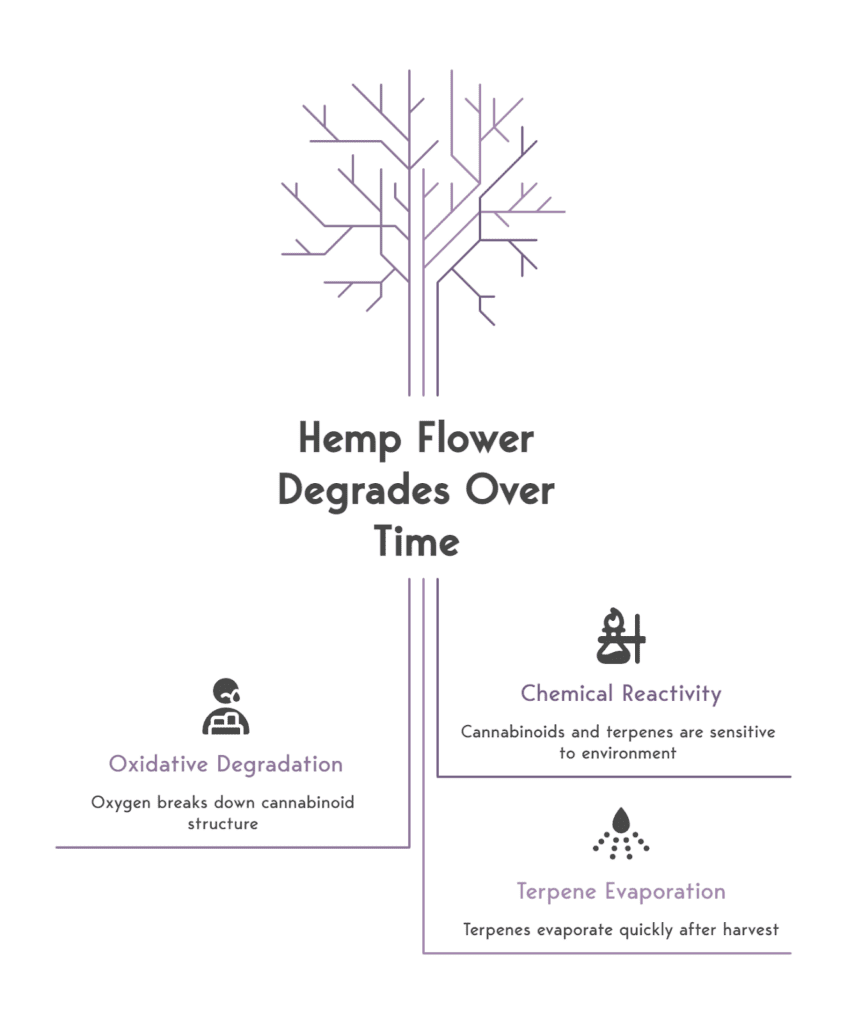
The compounds inside the trichomes, cannabinoids, terpenes, and flavonoids, are chemically reactive and sensitive to their environment. Time alone will change the profile of your flower, but the rate and severity of those changes depend heavily on how it’s stored.
Hemp flower’s potency comes primarily from THCa, the dominant cannabinoid in raw, unheated flower. THCa is non-psychoactive on its own, but the moment heat is applied through smoking or vaping, it converts into Delta-9 THC through a process called decarboxylation.
That conversion is what produces the effects people are actually buying hemp flower for. If you want to go deeper on that mechanism, what THCa flower actually is versus THC flower covers it thoroughly.
However, storage alone does not meaningfully trigger that conversion. Flower sitting in a jar at room temperature is not slowly building up THC. What is happening is oxidative degradation.
Oxygen exposure gradually breaks down cannabinoid structure, and both THCa and any THC present in the flower are affected. The longer flower sits and the less controlled the environment, the more the overall cannabinoid content erodes. The direction of change is always loss, never gain.
The degradation of THC specifically has been well-studied because it’s the compound most users care about. Once THCa converts to THC during use, or in any flower that has partially decarboxylated from heat or light exposure during storage, that THC follows a predictable decay path.
Research published by the UNODC tracked THC concentration in cannabis stored at room temperature over four years. On average, THC decreased by approximately 16.6% after one year, 26.8% after two years, 34.5% after three years, and 41.4% after four years.
Nearly half the active compound was gone by the four-year mark, with the steepest losses occurring in the first year.
When THC degrades, it doesn’t just disappear. It oxidizes and converts into cannabinol, or CBN, and this is where things get interesting.
CBN is a mildly psychoactive compound with a significantly weaker binding affinity to CB1 receptors than THC. But its effects feel noticeably different because CBN tends to produce sedation rather than the euphoric, clear-headed experience people associate with quality THC.
Research suggests CBN acts as a weak partial agonist at CB1 receptors, producing its characteristic sedative effects at lower potency than Delta-9 THC. This is why old flower can feel like it “hits different.”
It does, just not because it got stronger. The cannabinoid ratio has shifted toward a more sedating compound, making the experience heavier and foggier without adding any actual potency.
Terpenes are the chemical compounds responsible for the smell, flavor, and much of the functional character of a given strain. They also play a major role in how cannabinoids affect you through what’s called the entourage effect, where terpenes and cannabinoids interact synergistically to shape the overall experience.
A strain’s terpene profile is part of what makes it feel uniquely like itself, and terpenes are far more fragile than cannabinoids.
Unlike cannabinoids, which degrade gradually over months and years, terpenes begin evaporating almost immediately after harvest.
Research from Boveda indicates that up to 40% of a flower’s terpenes can be lost in just the first seven days post-cure without proper humidity protection.
Here’s what terpene loss actually does to a cannabis product:
The “old stash is stronger” idea has enough anecdotal backing that it keeps circulating. And it’s not that the people reporting it are wrong about what they experienced. It’s that the explanation is off. There’s a real mechanism behind what they felt, but it just isn’t potency.
When flower dries out beyond its ideal moisture range, it burns hotter and faster. A drier roll or bowl burns at a higher temperature, which can cause the user to inhale more smoke per hit in a shorter window.
That faster, hotter combustion can feel more intense in the moment, even though the flower is chemically weaker than it was fresh. On top of that, the shift in the cannabinoid profile toward CBN changes the quality of the experience. Sedation kicks in harder, clarity drops, and the overall effect feels heavier, which some users read as “stronger.”
There’s also a simple dosing factor. If someone buys flower that was labeled at 25% THCa but has been sitting for a year under suboptimal conditions, the actual THCa content at the time of smoking may be meaningfully lower.
To feel the same effects, they use more. Using more and then feeling high leads to the conclusion that the product “worked really well,” even though the flower itself degraded.
Published research consistently points in the same direction: time is not a friend to potency.
A 2024 study by Anresco Laboratories tracking cannabis storage at 4°C, 20°C, and 30°C found that total potential THC decreased by an average of 11.83% within the first 30 days alone.
By day 60, degradation exceeded 12.5% across all tested temperatures and container conditions. The most significant losses happened in the first month of storage, not in a slow, steady decline over the years.
If potency decreases over time regardless, the question becomes how much control you actually have over that timeline. The answer is quite a bit.
The three major environmental variables, light, heat, and humidity, each play their part in how quickly your flower degrades, and managing them together can meaningfully extend the window during which your flower performs as intended.
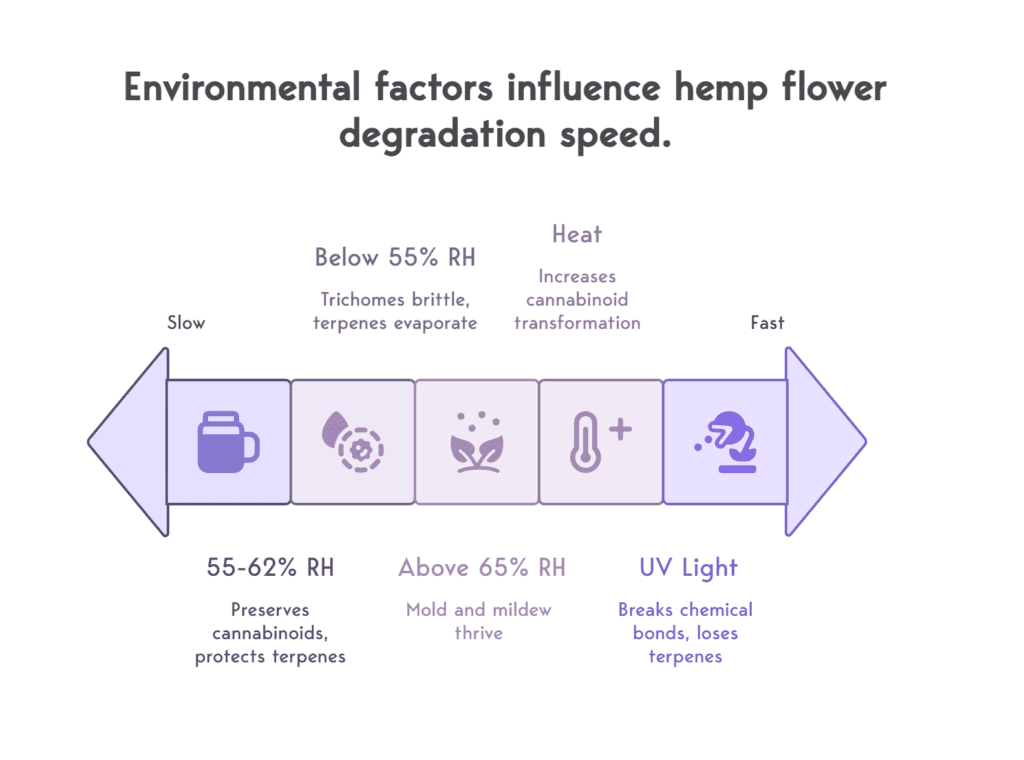
UV light is one of the most destructive forces acting on cannabinoids and terpenes in stored flower.
Photodegradation, the process by which light energy breaks chemical bonds, is well-documented as a primary cause of both terpene loss and THC breakdown. This is why amber glass jars dramatically outperform clear glass.
Heat compounds the problem significantly. A 2022 study published in Cannabis and Cannabinoid Research found that cannabinoid transformation rates increased with temperature, particularly as temperature approached 70°C, with degradation following predictable kinetic models.
Even modest ambient temperature increases accelerate the conversion of THC to CBN and the evaporation of volatile terpenes.
Humidity control is the third leg of the equation. The ideal relative humidity for stored hemp flower is between 55–62% RH. Here’s what happens outside that window:
Storing hemp flower correctly isn’t complicated, but most people skip one or two of the key steps and wonder why their flower doesn’t taste or feel the same a few months later.
If freshness and proper storage are the keys to getting the most out of hemp flower, it follows that the starting point matters just as much as the storage itself. High-quality genetics, clean cultivation, and tight moisture management from harvest through packaging give you the best baseline to work from.
The Blood Orange Sorbet Exotic flower jar from Twenty One Cannabis is a well-balanced hybrid coming in at 25% THCa with a terpene profile centered around myrcene, limonene, and caryophyllene.
That combination gives you citrus-forward flavor, mood elevation from the limonene, and anti-inflammatory support from caryophyllene.
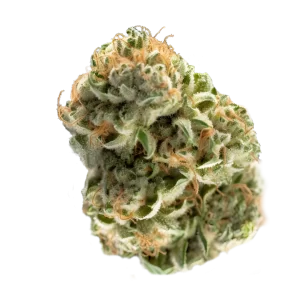
For users looking for maximum potency from the jump, the Purple Trainwreck THCa Flower comes in at 42–46% THCa thanks to its THCa isolate crystal infusion on the outside of each nug.
Purple Trainwreck carries a bold grape-and-berry flavor profile with limonene, myrcene, and pinene driving both its citrus-sweet taste and balanced hybrid effects. Because Icy Nugs start with a higher THCa concentration, they have more room to absorb some natural degradation over storage time.
The Granddaddy Pluto THCa Flower is a 24% THCa hybrid crossing Granddaddy Purple and Pluto Kush genetics, producing a complex terpene character with ripe berry, earthy kush, and citrus notes.
Its profile, dominated by myrcene, limonene, and pinene, makes it a great example of why terpene preservation matters as much as cannabinoid levels.
The cerebral onset that transitions into body relaxation depends on the terpene integrity staying intact. Picking this one up fresh and storing it in an airtight amber jar will protect the experience that the genetics were designed to deliver.
Consistency begins long before a product reaches your hands. At Twenty One Cannabis, every batch of hemp flower is sourced from physically vetted farms across Colorado, Oregon, California, and Arizona. These farms are selected for clean growing practices, authentic strain genetics, and rigorous post-harvest handling.
Every product carries a batch-specific Certificate of Analysis from an independent third-party lab, so you can verify potency and purity before you buy, not just take a brand’s word for it.
That transparency matters especially for flower, where cannabinoid and terpene content at the time of purchase is the only meaningful baseline you have.
Ready to start with flower that was worth storing right? Browse our full collection of premium THCa flower and find the strain worth protecting.
No. Drying out is a sign of moisture loss, which causes trichomes to become brittle and break off, reducing cannabinoid and terpene content. Dry flower may feel harsher or burn differently, which can alter the smoking experience, but this is not the same as potency increasing. The actual cannabinoid levels decline as flower loses its ideal moisture content.
Well-stored hemp flower in an airtight, opaque container at 55–62% relative humidity can maintain reasonable cannabinoid stability for one to two years. However, terpene content — which significantly shapes flavor and effect — begins depleting within the first weeks post-cure. For the best all-around experience, consuming within two to four months of purchase is ideal.
Yes, and this is the mechanism behind the “old weed hits different” experience many users report. As THC degrades into CBN, the cannabinoid profile of the flower shifts toward a more sedating compound. The feeling of heaviness or fatigue after smoking older flower is typically caused by elevated CBN levels rather than any increase in potency.
Freezing significantly slows cannabinoid degradation and is effective for long-term storage. However, it comes with a tradeoff: trichomes become brittle when frozen and can break off with handling. If you freeze flower, do it in an airtight container, avoid opening the container until it has fully returned to room temperature, and minimize handling of frozen buds.
The most immediate signs are sensory. Degraded flower tends to smell less vibrant, flat, or faintly like hay. The buds will feel crumbly or overly dry rather than slightly spongy when gently squeezed. On smoke, the flavor will be harsher and less distinct. The effects may feel heavier or more sedating than expected — a signal that CBN has accumulated. If your flower came with a COA, keep in mind that it represents the cannabinoid profile at time of testing, not necessarily at time of consumption.


Doctor of Pharmacy, Pharmaceutical Sciences University of Colorado
Co-Founder & CEO at Arvida Labs

You must be over 21 to enter.
GET NOTIFIED ABOUT ONLINE SALES AT 21 CANNABIS!