

FOR HIGH ROLLERS
 Fabian Raemy
Quick Answer: THCa is non-psychoactive in its raw form and will not produce a high until heat is applied. Once smoked, vaped, or dabbed, THCa converts to Delta-9 THC through decarboxylation, and at that point, dosage thresholds vary significantly based on your tolerance, body chemistry, and the type of product you’re using.
Most beginners feel effects from as little as 1–3 puffs of THCa flower containing 15–20% THCa, while experienced users may consume significantly more before reaching the same result.
You’ve bought THCa flower, checked the label, seen a percentage in the mid-20s, and thought: “How much of this do I actually need?” It’s a question more people are asking than ever, and the vague answers floating around online aren’t helping.
Part of the confusion is structural. THCa percentages look like traditional THC percentages, but they don’t behave the same way until heat enters the equation.
On top of that, switching from Delta-8 or coming in fresh with no tolerance adds even more variables that most dosage guides completely ignore. A number on a label can’t tell you what your body is going to do with it.
The good news is that there’s real, usable logic to THCa dosing once you know how the compound works and what factors actually shape your experience. This guide breaks all of it down: from the conversion math behind that percentage on your label to practical puff-count guidance for beginners, intermediate users, and high-tolerance consumers across different product types.
Before any dosage numbers make sense, you need to know what you’re actually working with. THCa (tetrahydrocannabinolic acid) is the raw, unactivated form of THC that exists in freshly harvested and dried cannabis flower.
It is not the same as THC, at least not until heat gets involved. That distinction is everything when figuring out how much you need.
THCa and Delta-9 THC share nearly identical molecular structures, with one key difference: THCa carries an extra carboxyl group attached to its molecular chain.
That extra carboxyl group prevents THCa from binding effectively to the CB1 receptors in your brain, which are the same receptors that produce the psychoactive effects people associate with being high. As a result, raw THCa produces no meaningful intoxication, no matter how much you consume.
When heat is introduced, whether from a lighter, a vape coil, or a dab rig, that carboxyl group breaks off in a process called decarboxylation.
What’s left is Delta-9 THC, which binds freely to CB1 receptors and produces the full psychoactive effect. You can read more about this process in detail in our breakdown of does THCa get you high. The core takeaway for dosing purposes is simple: every dosage threshold discussed in this guide assumes heat activation. Raw consumption doesn’t apply here.
The percentage of THCa listed on a product label is not the same as the percentage of active THC you’ll actually receive.
During decarboxylation, the molecular weight of THCa drops as CO2 is released.
A 2016 study confirmed that decarboxylation of cannabinoid acids is necessary for conversion to their bioactive neutral form, and that this process involves measurable molecular weight loss.
The conversion formula accounts for this.
THCa percentage x 0.877 = approximate Delta-9 THC post-decarboxylation.
The 0.877 figure comes from the ratio of THC’s molecular weight to THCa’s molecular weight. In practice, real-world yields typically run between 70–85% efficiency due to heat inconsistencies, minor degradation, and cannabinoid loss during combustion.
This math also explains why 20% THCa flower and 20% THC flower don’t hit identically. The THCa version will slightly underperform that label figure after accounting for conversion losses. Knowing this helps you set more accurate expectations before you ever light up.
Before landing on a dosage number, several personal and product variables determine how much is actually enough or too much. Two people can smoke the same strain from the same bag and have completely different experiences. Here’s why.
Tolerance is the single biggest variable in THCa dosing. It determines how sensitive your CB1 receptors are to THC at any given moment.
Research published in Neuroscience & Biobehavioral Reviews confirms that regular cannabis use reduces subjective responses to intoxication over time, a pattern consistent with CB1 receptor downregulation. In plain terms, the more frequently you’ve been using cannabis, the more THC it takes to feel the same effect.
For someone who has never used cannabis or hasn’t used it in months, a very small amount of activated THCa is enough to produce noticeable psychoactive effects.
For a daily user, that same amount might register as barely anything. Tolerance resets are worth knowing about here. Most users report measurable sensitivity returning after as little as 48–72 hours of abstinence, with significant receptor restoration occurring over 2–4 weeks of a full break.
How you consume THCa changes the dosing equation dramatically. Each delivery method delivers a different amount of activated THC at a different speed, which directly affects how much you need and how easy it is to pace yourself.
These factors are real but often overstated in general cannabis guides.
Body weight influences how THC distributes in fatty tissue and how long effects persist, but it has less impact on initial onset intensity than most people assume. Metabolism speed affects how quickly THC is processed, which can shift the duration and tail-end of your high more than the peak.
Genetic sensitivity is harder to predict, but absolutely present. Research suggests that cannabinoids produce a biphasic dose-response, meaning low doses can stimulate while higher doses inhibit, and that tipping point varies between individuals.
Some people are highly sensitive to THC at very low doses; others process it quickly and require more for equivalent effects. If you’re new to THCa or new to cannabis in general, assume you may fall into the sensitive category until you know otherwise.
| Factor | Low Impact | High Impact | What to Do |
| Tolerance level | New or infrequent user | Daily/heavy user | Start lower; scale based on experience |
| Consumption method | Smoked flower | Concentrates/dabs | Fewer puffs from vapes vs. flower |
| THCa % on label | 15–18% | 25–30%+ | Apply 0.877 conversion to estimate THC |
| Body metabolism | Fast metabolizer | Slow metabolizer | Wait longer between doses if slow |
| Prior cannabinoid use | Delta-8 background | THC-naive | THCa will feel stronger than Delta-8 |
| Sensitivity | Low (high tolerance) | High (first-time) | Always start with minimum dose |
Now that the variables are clear, here’s how dosage actually breaks down across experience levels and product types.
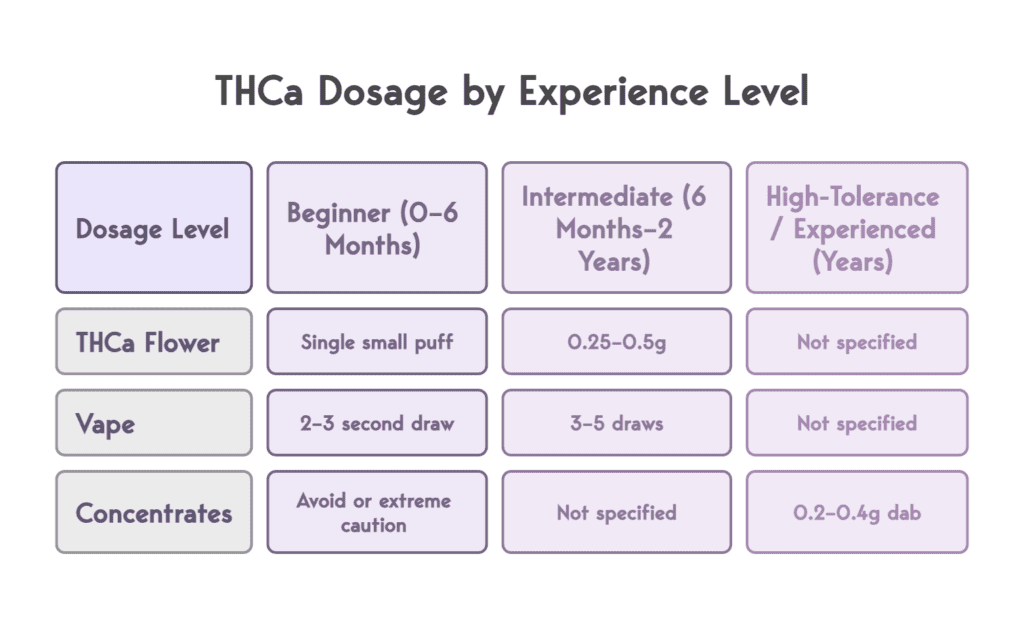
Beginners should treat every session as a calibration exercise. Your receptors are highly sensitive, and activated THCa can be a lot sometimes.
Intermediate users, those with 6 months to 2+ years of consistent use, have established some tolerance but may still experience intensity variation between strains and batches, especially when trying a new product line.
Experienced users with years of heavy use have often built substantial CB1 receptor tolerance. At this level, the format and potency of the product matter more than puff count.
The right product for your dosage needs is rarely about finding the highest THCa percentage. It’s about matching the format and potency level to where you actually are as a consumer.
Here are four options that map cleanly onto different points in the experience spectrum.
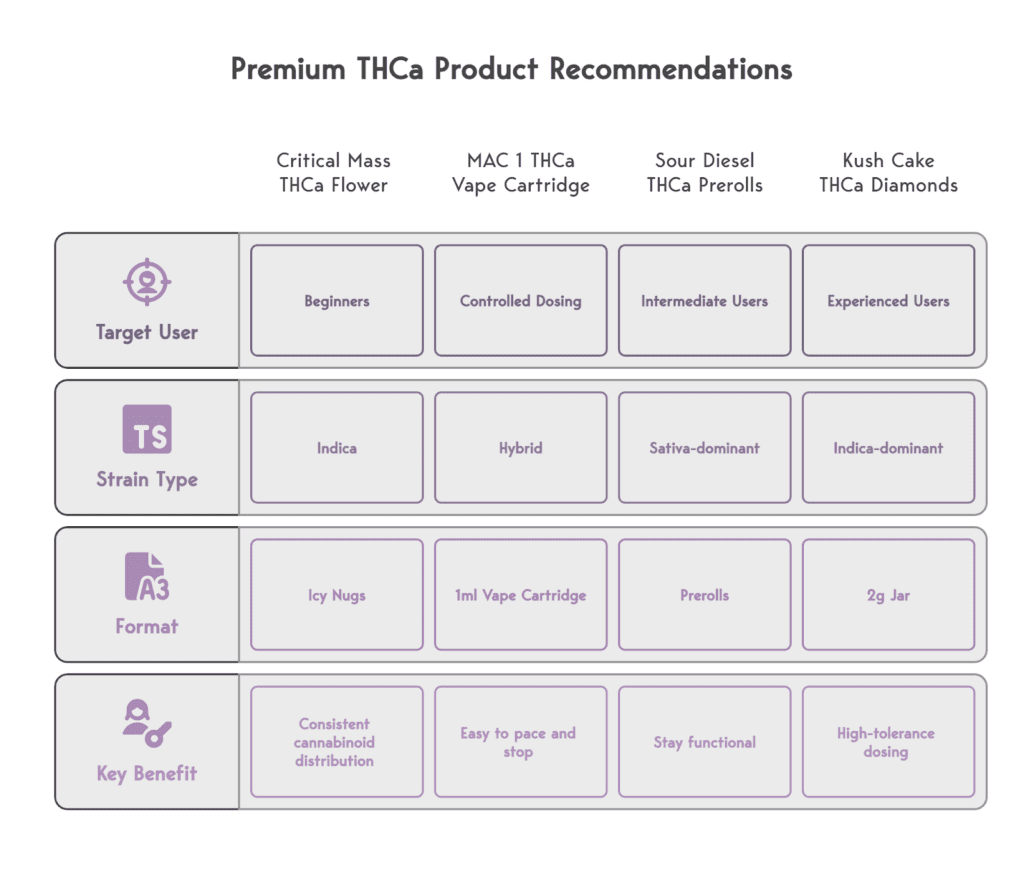
For beginners or those returning from a tolerance break, the Critical Mass THCa Flower in Icy Nugs format is a practical starting point.
Critical Mass is a relaxing, body-forward indica known for smooth onset and manageable intensity. Packaged in the Icy Nugs format with tight, well-cured buds, it delivers consistent cannabinoid distribution across the jar, which matters when you’re trying to dose accurately one hit at a time.
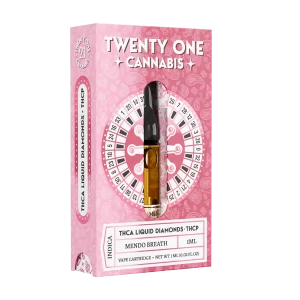
If you want controlled, efficient dosing in a portable format, the MAC 1 THCa 1ml Vape Cartridge is worth a close look. MAC 1 is a cult-status hybrid with a clean cannabinoid profile that leans euphoric without going heavy.
The 1ml cart format means you’re getting a manageable amount of material with clear per-draw increments, easy to pace, easy to stop when you’ve reached your threshold.
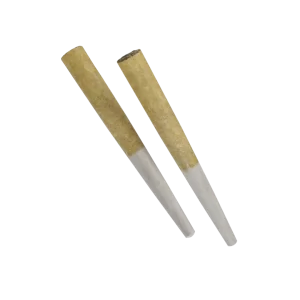
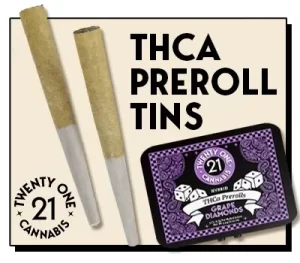
For intermediate users who prefer a ready-to-go format with no grinding or packing, the Sour Diesel THCa Prerolls are a reliable option.
Sour Diesel is a sativa-dominant strain known for energizing, focused effects, which is a useful choice when you want to stay functional rather than couch-locked. The preroll format also naturally limits per-session consumption, since you can stub it out between hits and come back to it.
For experienced users comfortable with concentrates, the Kush Cake THCa Diamonds Jar is where high-tolerance dosing makes sense. Kush Cake is an indica-dominant cross with deep body effects and sedating qualities that work well in a concentrate format.
The 2g jar gives you enough material for multiple sessions, and the diamond form factor allows for precise dab sizing, which is critical when working at this potency level.
Dosage guidance only works when you can trust the numbers on the label. That’s what makes the COA (Certificate of Analysis) process so important and why not every THCa brand puts the same weight on it.
Twenty One Cannabis tests every batch through independent third-party labs, with results available so you can verify exactly what’s in your product before it ever reaches you. The farm-sourced inputs from vetted growers in Colorado, Oregon, California, and Arizona mean the genetics and cultivation practices behind those percentages are consistent from batch to batch.
When a product label says 24% THCa, that number should mean something reliable and not a best-case-scenario figure inflated to move units. That’s the standard Twenty One Cannabis holds itself to across every product type, from flower jars to vape carts to concentrate diamonds.
Browse our full collection of premium THCa products and find the right format for where you are right now with Twenty One Cannabis.
For most beginners, 1–3 puffs of THCa flower or 1 short draw from a vape is enough to produce noticeable effects. Intermediate users typically need 3–6 puffs of flower or 3–5 vape draws per session. Experienced users vary widely depending on tolerance and product potency. The only reliable answer is to start with one puff, wait 10 minutes, and add from there.
Yes, for most people. After applying the 0.877 decarboxylation conversion factor, 20% THCa flower yields approximately 17.5% active THC under ideal conditions — comparable to premium cannabis from a licensed dispensary. Beginners should treat 20% THCa as a high-potency starting point and dose accordingly.
When smoked or vaped, decarboxylation is immediate, and effects typically begin within 5–10 minutes of inhalation. Concentrates can produce onset in under 3 minutes. If you’re using THCa in an edible that was pre-decarboxylated, expect 30–90 minutes for onset, similar to any cannabis edible.
Yes. Once heated and decarboxylated, THCa converts directly into Delta-9 THC. It becomes chemically identical to the THC in traditional cannabis. The high produced by smoked or vaped THCa flower is the same compound producing the same receptor activation. Strain genetics and terpene profile determine the character of the experience, not the fact that it started as THCa rather than THC.
Actually, the reverse is typically true. THCa converts to Delta-9 THC, which has a higher binding affinity for CB1 receptors than Delta-8 THC. Most users transitioning from Delta-8 to THCa find that THCa-derived THC is significantly more potent per equivalent dose. If you’re making that switch, reduce your usual Delta-8 puff count by at least 30–50% and titrate up from there.
Nothing psychoactive. Raw THCa consumed without prior decarboxylation passes through your digestive system without converting to THC. Your body cannot perform decarboxylation the way heat does. You’d need to bake or otherwise heat the flower to activate it before consuming it in any edible application.


Doctor of Pharmacy, Pharmaceutical Sciences University of Colorado
Co-Founder & CEO at Arvida Labs
You must be over 21 to enter.
GET NOTIFIED ABOUT ONLINE SALES AT 21 CANNABIS!