

FOR HIGH ROLLERS

 Lindsey Goldstein
Quick Answer: THCp flower produces an intense psychoactive experience that’s significantly stronger than regular THC flower. With a binding affinity 33 times greater than Delta-9 THC at CB1 receptors, THCp flower delivers potent, long-lasting effects that experienced users describe as 5-10 times more powerful than traditional cannabis, making it suitable primarily for high-tolerance consumers seeking maximum potency.
If you’re researching THCp flower, you’re probably wondering whether this cannabinoid lives up to the hype surrounding its supposed super-potency. Maybe you’ve tried every high-THC strain available and still find yourself chasing stronger effects, or perhaps you’re concerned about accidentally consuming something far more powerful than intended. The confusion around THCp is understandable. With claims ranging from “30 times stronger than THC” to warnings about synthetic cannabinoids, there’s a lot to learn here before adding these flowers to your cart.
While there are folks trying out THCp, there’s still a good chunk of consumers unaware of what THCp can do for you. This knowledge gap matters because THCp flower isn’t just another high-THC option. It’s a fundamentally different experience that demands respect and understanding.
Whether you’re a concentrate enthusiast looking for flower that hits harder or a curious consumer evaluating new cannabinoids, knowing exactly what THCp flower does (and doesn’t do) should be checked off on your to-do list before you even think about consumption.
THCp (tetrahydrocannabiphorol) represents one of the most significant cannabinoid discoveries since THC itself. Italian researchers first identified this compound in 2019, finding that it naturally occurs in certain cannabis strains at trace levels, normally less than 0.1% in traditional flower. What makes THCp remarkable isn’t just its rarity but its unique molecular structure: a seven-carbon alkyl side chain compared to Delta-9 THC’s five-carbon chain.
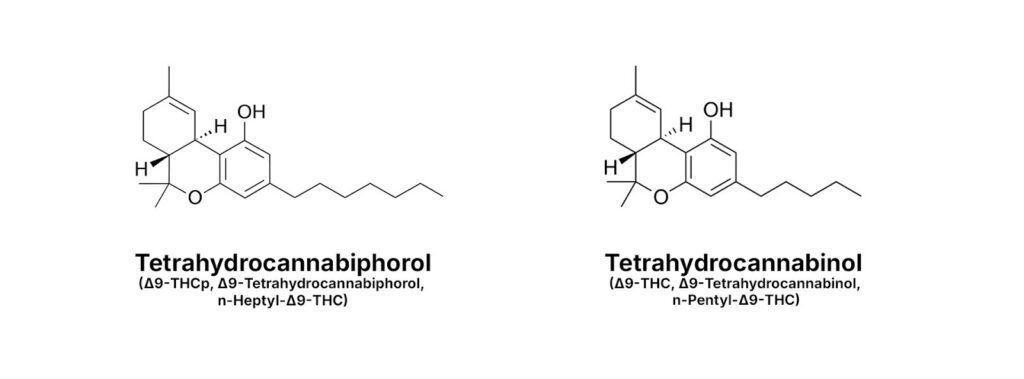
This structural difference fundamentally changes how THCp interacts with your endocannabinoid system. While Delta-9 THC interacts with the CB1 receptors fairly well, THCp’s extended carbon chain creates a more secure binding, approximately 33 times stronger according to research published in Scientific Reports. This enhanced binding affinity translates directly into more intense psychoactive effects, longer duration, and lower threshold doses for achieving desired results.
Modern THCp flower production involves carefully controlled processes that infuse high-quality hemp flower with THCp distillate and complementary cannabinoids.
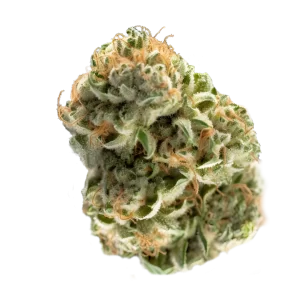
Reputable producers like Twenty One Cannabis combine naturally-derived THCp with premium THCa flower, creating products that deliver consistent potency while maintaining the full-spectrum benefits of traditional cannabis. The result is a flower that looks identical to standard cannabis but contains measurable amounts of THCp alongside other cannabinoids.
The conversation around THCp potency often gets oversimplified into clickbait headlines, but you need to look into both scientific data and real-world experiences to fully understand the cannabinoid’s potency. Laboratory binding affinity studies show THCp connects to CB1 receptors with an EC50 value of 1.2 nM compared to Delta-9 THC’s 40 nM (lower means stronger binding affinity). These technical measurements confirm THCp’s superior receptor activation at the molecular level.
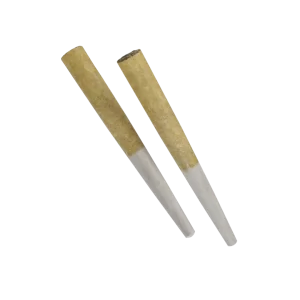
In practical terms, users report that THCp flower containing just 1-2% THCp concentration delivers effects comparable to concentrates testing at 70-80% total THC. This isn’t marketing exaggeration. It’s the result of THCp’s enhanced bioavailability and receptor activation. A single joint of quality THCp flower, like All Gas OG Indica, can produce effects that seasoned smokers compare to dabbing, but with the familiar ritual and flavor profile of flower consumption.
The potency difference becomes apparent in both onset timing and duration. Unlike Delta-9 THC’s relatively rapid effects, THCp often presents a slightly delayed but more gradual intensification, sometimes taking 10 to 15 minutes to manifest when smoked or vaped fully. The effects typically last anywhere from 6-12 hours when smoked or vaped, considerably longer than standard THC flower. However, this number can vary greatly based on your dosage, the percentage quantity of THCp in the flower, and your metabolism. This extended timeline requires patience to avoid overconsumption, as many users make the mistake of taking additional doses before the initial effects fully develop.

The THCp flower experience differs from standard cannabis in both intensity and character. Users consistently describe an initial rush of cerebral stimulation that’s more pronounced than even the headiest sativa strains, followed by deep body relaxation that can border on immobilizing at higher doses. This dual-phase effect profile makes strain selection particularly important. A THCp sativa like Candyland might keep you energized despite the compound’s inherent potency, while indica varieties can produce couch-lock that lasts entire evenings.
Physical sensations often include enhanced tactile sensitivity, pronounced time dilation, and what users describe as “waves” of euphoria that pulse through the body.
Unlike the relatively predictable plateau of Delta-9 THC, THCp creates a more versatile experience with multiple peaks and valleys throughout its duration. Colors may appear more saturated, music gains dimensional depth, and simple activities like eating become intensely pleasurable experiences.
The mental effects lean heavily toward introspection and creativity, though this varies significantly by dose. Microdoses (under 0.5mg THCp) can improve focus and motivation without overwhelming psychoactivity. Standard doses (1-2mg) produce classic cannabis euphoria amplified several fold. High doses (3mg+) can trigger profound altered states that must only be tried by seasoned cannabis users.
The “synthetic versus natural” debate surrounding THCp requires nuance that often gets lost in marketing claims and forum arguments. THCp is definitely a natural cannabinoid. Researchers have identified it in Italian medical cannabis strains like FM2 at concentrations around 0.0029-0.0037%. However, these trace amounts make natural extraction economically impossible for commercial production.
Most THCp in the market comes from hemp-derived CBD through a process called isomerization. Licensed laboratories convert CBD into THCp using controlled chemical reactions, similar to how vitamin C supplements are produced from glucose, despite vitamin C occurring naturally in oranges. This semi-synthetic production method creates molecularly identical THCp to what cannabis plants produce naturally. The end compound is the same whether extracted from rare strains or converted from hemp.
Quality and safety depend entirely on production standards rather than origin. Reputable brands provide detailed lab testing showing, not just THCp content, but also screening for residual solvents, heavy metals, and reaction byproducts.
When you purchase from established companies like Twenty One Cannabis, you’re getting THCp that’s been purified, tested, and infused using pharmaceutical-grade processes that guarantee consistency and safety.
THCp occupies a complex position in cannabis law that varies dramatically by jurisdiction. At the federal level, THCp derived from hemp (containing less than 0.3% Delta-9 THC) remains technically legal under the 2018 Farm Bill. This interpretation allows companies to ship THCp products to states where cannabis remains prohibited, creating access for consumers in prohibition states who want potent cannabinoid experiences.
However, state laws increasingly target novel cannabinoids regardless of federal hemp provisions. Several states have explicitly banned or restricted THCp, while many more have pending legislation. These regulations often group THCp with other alternative cannabinoids like Delta-8 and THC-O, creating blanket bans on anything beyond CBD and Delta-9 THC. Even in legal cannabis states, some regulators view THCp skeptically due to its potency and semi-synthetic production methods.
The changing regulations around synthetic cannabinoids make it extremely complicated to mention exact state laws here, but if you’re planning on ordering THCp products, it’s best to do some research beforehand.
The creation of THCp flower is a complicated chemical process with careful quality control that goes far beyond simply spraying distillate on hemp.
Premium producers follow a multi-stage process that ensures consistent potency and quality throughout each batch.
Premium producers begin with high-THCa hemp flower that’s been cultivated specifically for infusion. These dense, trichome-rich buds can properly absorb and hold cannabinoid distillates without becoming oversaturated or losing their structure. The quality of the base flower determines how well the final product maintains its appearance, burns evenly, and delivers consistent effects.
The THCp distillate itself undergoes multiple refinement stages to achieve pharmaceutical-grade purity:
The infusion process requires precision temperature control and specialized equipment to ensure even distribution:
Each batch undergoes potency testing at multiple stages to ensure consistent THCp distribution throughout, guaranteeing that every nug delivers the expected effects.

THCp’s enhanced potency demands serious respect for dosing and a thorough understanding of potential side effects. The most commonly reported adverse effects mirror those of high-dose THC but with greater intensity: dry mouth, red eyes, increased heart rate, and temporary anxiety or paranoia. However, THCp’s extended duration means these effects can persist much longer than the 2-3 hours typical of standard cannabis.
THCp may have a lower threshold for triggering anxiety responses compared to Delta-9 THC, particularly in users without tolerance. First-time users report experiencing overwhelming sensations even from single hits, describing feelings of being “too high” that can trigger panic responses. These reactions are temporary and not dangerous, but they’re unpleasant enough to ruin the experience entirely.
Proper THCp flower dosing requires abandoning everything you know about regular cannabis consumption. Where you might smoke an entire joint of standard flower, THCp flower demands a completely different approach. The golden rule for THCp is to start lower than you think necessary and wait longer than feels comfortable before redosing.
For first-time THCp users, regardless of cannabis tolerance, begin with one small puff (1-2 second inhale) and wait a full 30 minutes before considering additional consumption. This might seem overly cautious, but THCp’s delayed peak means effects continue building for 20-30 minutes after inhalation. Reddit is full of uncomfortable experiences stemming from users taking multiple hits in rapid succession, only to find themselves overwhelmed when the cumulative effects manifest.
Experienced cannabis users with high tolerance can start with 2-3 small puffs, but should still respect the 30-minute waiting period. The temptation to smoke THCp flower like regular cannabis is strong. It looks the same, smells the same, and the ritual feels familiar. But treating THCp flower like standard bud is the fastest route to an uncomfortably intense experience. Consider using a one-hitter or small bowl rather than rolling joints, as portion control becomes much easier with controlled delivery methods.
Selecting quality THCp flower requires looking beyond potency claims to examine terpene profiles, base flower quality, and production transparency. Twenty One Cannabis offers three distinct THCp flower varieties that showcase the compound’s versatility across different effect profiles and user preferences.
All Gas OG Indica delivers the heavy-hitting body effects THCp is famous for, enhanced by a classic OG terpene profile featuring myrcene, limonene, and caryophyllene. Testing at 30.04% total cannabinoids with 1.8% THCp content, this strain is built for evening relaxation and deep sleep. The dense, crystal-coated buds break apart to reveal purple undertones and a pungent fuel aroma that OG enthusiasts recognize immediately. Users report powerful muscle relaxation, appetite stimulation, and sedation that makes this ideal for ending stressful days or managing chronic pain.
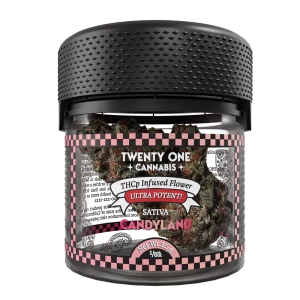
Candyland Sativa proves that THCp flower doesn’t always mean couch-lock. With uplifting terpinolene and pinene dominance, this 29.8% total cannabinoid strain (1.5% THCp) maintains mental clarity while delivering potent euphoria. The sweet, candy-like flavor profile makes it approachable for users who find traditional cannabis too harsh, while the energizing effects support creative projects, social activities, and daytime adventures, just in smaller doses than typical sativa flower.
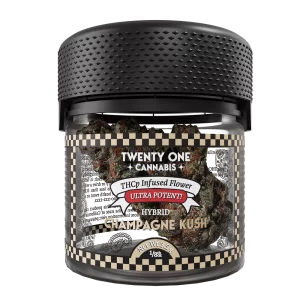
Champagne Kush Hybrid strikes the perfect balance for users wanting THCp’s intensity without committing to pure indica or sativa effects. At 31.2% total cannabinoids with 2% THCp, it’s the strongest option in Twenty One’s lineup. The champagne-inspired flavor combines sweet grape notes with subtle earth undertones, while effects blend cerebral stimulation with progressive body relaxation. This versatility makes it ideal for users still discovering their THCp preferences or those who enjoy different effects at different doses.
The THCp flower market is flooded with products of wildly varying quality, from premium crystal-coated buds to questionable sprayed hemp that barely holds together. Your experience with this powerful cannabinoid depends entirely on the source you choose. Low-quality THCp flower often suffers from uneven distribution, harsh smoke, and unpredictable potency that can turn what should be an elevated experience into an uncomfortable ordeal.
Twenty One Cannabis understands that THCp demands respect, precision, and transparency. Each batch of our THCp flower starts with carefully selected, dense nugs that can properly hold the infusion without becoming oversaturated. We provide complete lab testing results showing not just THCp percentages but also screening for contaminants, ensuring you know exactly what you’re consuming. Our three distinct strains offer different effect profiles while maintaining the consistent quality that high-tolerance users and cannabinoid explorers expect.
Whether you choose the sedating embrace of All Gas OG, the creative spark of Candyland, or the versatile effects of Champagne Kush, you’re getting lab-tested flower with verified potency and consistent effects.
Visit Twenty One Cannabis today to learn the difference that quality, transparency, and real cannabinoid education make.
Yes, THCp will absolutely trigger positive results on standard cannabis drug tests. Since these tests detect THC metabolites rather than specific cannabinoids, THCp breaks down into similar compounds that register as marijuana use. THCp’s extended duration means metabolites may remain detectable even longer than traditional THC.
Theoretically, it is possible, but due to THCp’s potency, it won’t be quick. However, it’s important only to increase your dosage if you’re extremely positive that the current dose isn’t enough anymore.
Dry herb vaporizers offer the most control over THCp flower consumption, allowing precise temperature adjustment and measured doses. Set temperatures between 380-410°F to fully activate THCp while preserving terpenes. Alternatively, small glass pipes or one-hitters provide portion control that’s difficult with joints or blunts. Whatever method you choose, the key is starting small — you can always consume more, but you can’t unconsume what you’ve already smoked.
While THCp flower typically contains 1-2% THCp compared to concentrates reaching 90%+ total cannabinoids, the enhanced binding affinity means effects can feel surprisingly comparable. A properly dosed session with quality THCp flower can usually exceed the intensity of dabs, though concentrates still provide more immediate, controllable dosing. Many users prefer THCp flower specifically because it offers concentrate-level effects through familiar consumption methods.



Doctor of Pharmacy, Pharmaceutical Sciences University of Colorado
Co-Founder & CEO at Arvida Labs

You must be over 21 to enter.
GET NOTIFIED ABOUT ONLINE SALES AT 21 CANNABIS!