


FOR HIGH ROLLERS
 Lindsey Goldstein
Quick Answer: Live resin, rosin, and distillate mainly differ by how they are extracted and how many natural compounds from the plant remain. Live resin uses fresh-frozen cannabis and solvent extraction to preserve terpenes and deliver strain-accurate flavor. Rosin is solventless, pressed with heat and pressure, producing a clean full-spectrum extract but with lower yields and higher cost. Distillate is heavily refined to isolate cannabinoids (often 80–95% purity), stripping most terpenes and flavor. In practice, live resin and rosin offer richer, terpene-driven effects, while distillate provides stronger but more uniform potency.
The concentrate category covers everything that has been extracted from the cannabis plant and refined down from raw flower into a more potent, compact form. What separates live resin, rosin, and distillate from each other is not just potency. It is the method used to pull the desired compounds out of the plant and what gets preserved or lost along the way.
Cannabis plants produce hundreds of compounds in their trichomes, the resin glands that coat the flower. These include cannabinoids like THCa and Delta-9, but also terpenes, flavonoids, and minor cannabinoids that together shape the experience.
The extraction method determines how many of those compounds survive into the final product. This matters whether you are buying a vape cart, a dab, or an infused preroll, because the same strain can hit completely differently depending on how it was extracted.
Terpenes are the aromatic compounds found throughout the cannabis plant, and they are notoriously fragile. They begin degrading when the plant is cut, continue breaking down during drying, and are highly sensitive to heat and pressure during processing.
Terpenes affect far more than flavor. They interact with cannabinoids in ways that can shift the character of a high noticeably.
Research published in the Journal of Cannabis Research documents terpene losses of 31% after just one week of air drying, climbing to over 55% after three months of conventional storage, compared to freshly harvested plant material. This is why the extraction method is so decisive. A process that starts with fresh-frozen material and uses low-temperature solvents captures an entirely different chemical profile than one that starts with dried, cured biomass and applies high heat.
The entourage effect, the theory that cannabinoids and terpenes produce more complex effects together than any single compound in isolation, is what makes terpene preservation such a meaningful factor when comparing these three concentrate types.
The Journal of Cannabis Research above reviewed 93 extraction studies, further confirming that different processing methods result in dramatically different compound retention, reinforcing why starting material and method both matter.
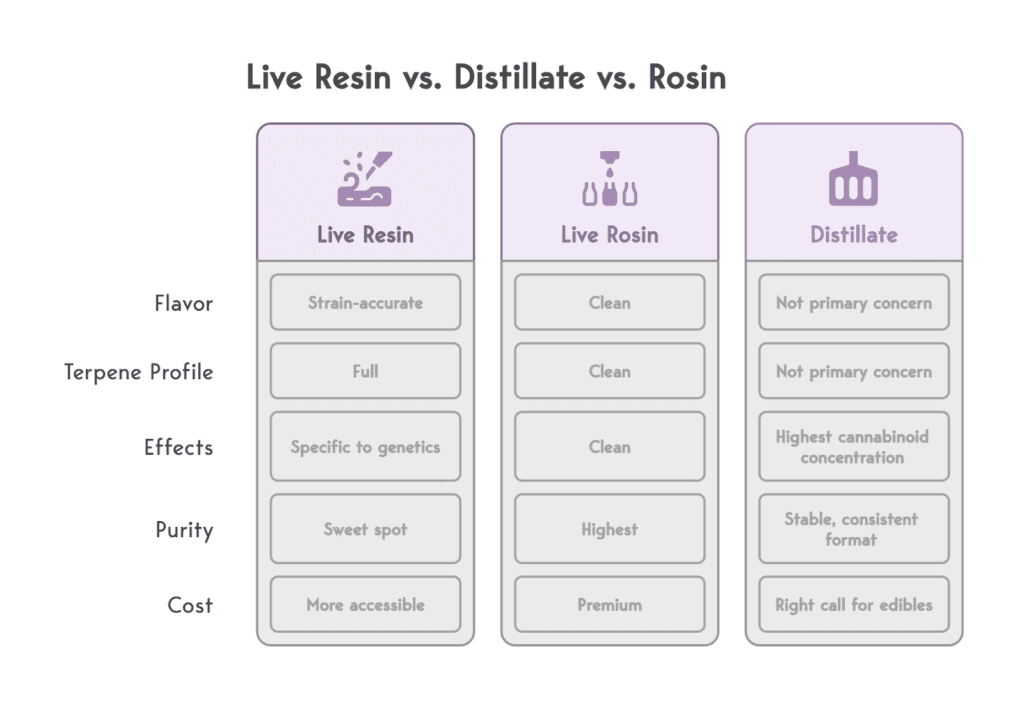
Before getting into each type, it is worth framing the bigger picture. Extracts generally fall into two camps: solvent-based and solventless. Here is how they differ in practice:
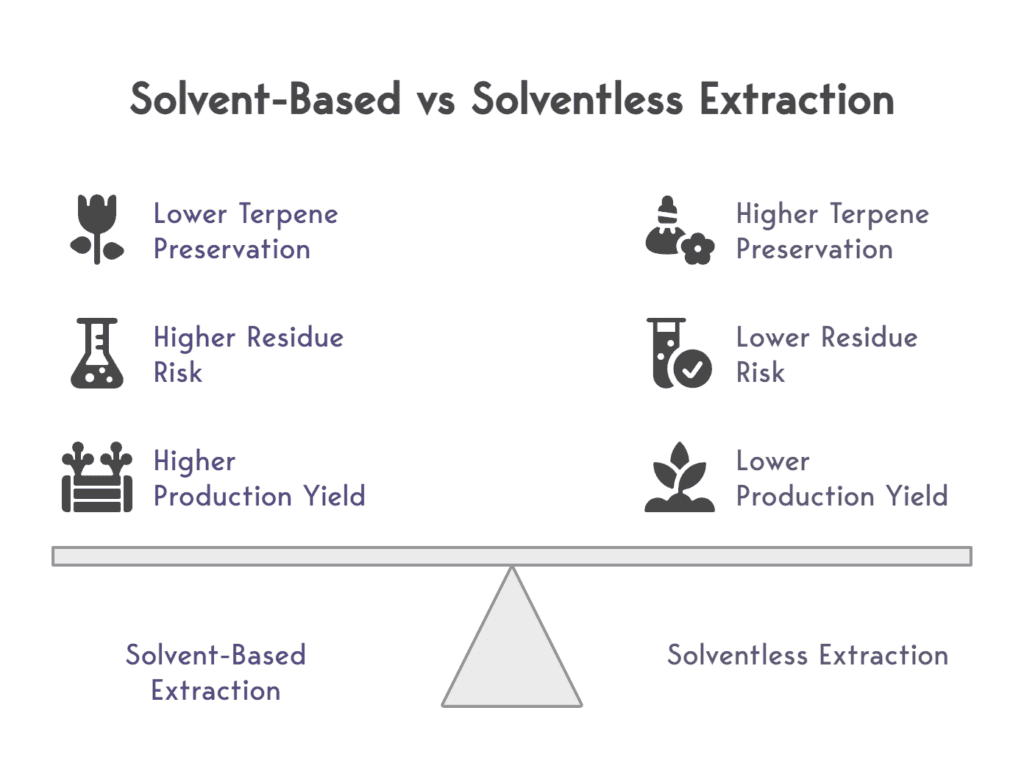
Each of these three concentrates has a distinct production process that directly shapes its chemical profile, potency, flavor, and feel. The differences are not marketing. They are rooted in the chemistry of what survives each extraction method.
Live resin starts before drying ever happens. The cannabis plant is harvested and immediately flash-frozen, a step that locks in the terpene and cannabinoid profile the plant had at the exact moment of harvest.
Processors then run this frozen material through a hydrocarbon extraction at very low temperatures. Because the solvents used in live resin extraction are nonpolar and applied cold, they dissolve cannabinoids and terpenes efficiently while leaving behind unwanted plant matter like chlorophyll and waxes.
The result is an extract that maintains what many call a “live” profile, meaning it closely mirrors the full chemical snapshot of the living plant rather than the dried version most consumers interact with.
Live resin differs from liquid diamonds in that it retains a much broader terpene spectrum in its native, sauce-like consistency rather than being isolated into crystalline form. This is why live resin tends to smell and taste dramatically closer to the actual strain than most other concentrate formats.
An important thing to mention here is that live resin does use solvents, and it is critical that those solvents are fully purged before the product reaches a consumer. When it is not, the product can taste chemical and cause irritation.
To summarize:
Rosin is the simplest concentrate in terms of chemistry, and that simplicity is its strongest selling point. No solvents. No chemical inputs whatsoever. The process involves placing cannabis flower, kief, or bubble hash between two heated plates under significant pressure, which forces the resin to flow out of the plant material and collect on the surface below.
When rosin starts with fresh-frozen bubble hash rather than dried flower, it is called live rosin, and it occupies the upper tier of what solventless extraction can achieve.
The cold temperatures used in preparing bubble hash and the low-pressure pressing that follows allow live rosin to capture a terpene profile that rivals live resin. Live rosin vs live resin vs distillate is a common discussion among concentrate users, and live rosin consistently gets praised for its clean flavor and the fullness of its effects.
The tradeoff with rosin is yield and scalability. Producing rosin from high-quality starting material is labor-intensive and generates less finished product per gram of input compared to solvent-based methods. That cost is passed to the consumer, which is why premium live rosin concentrates often sit at the highest price points in any dispensary.
To summarize:
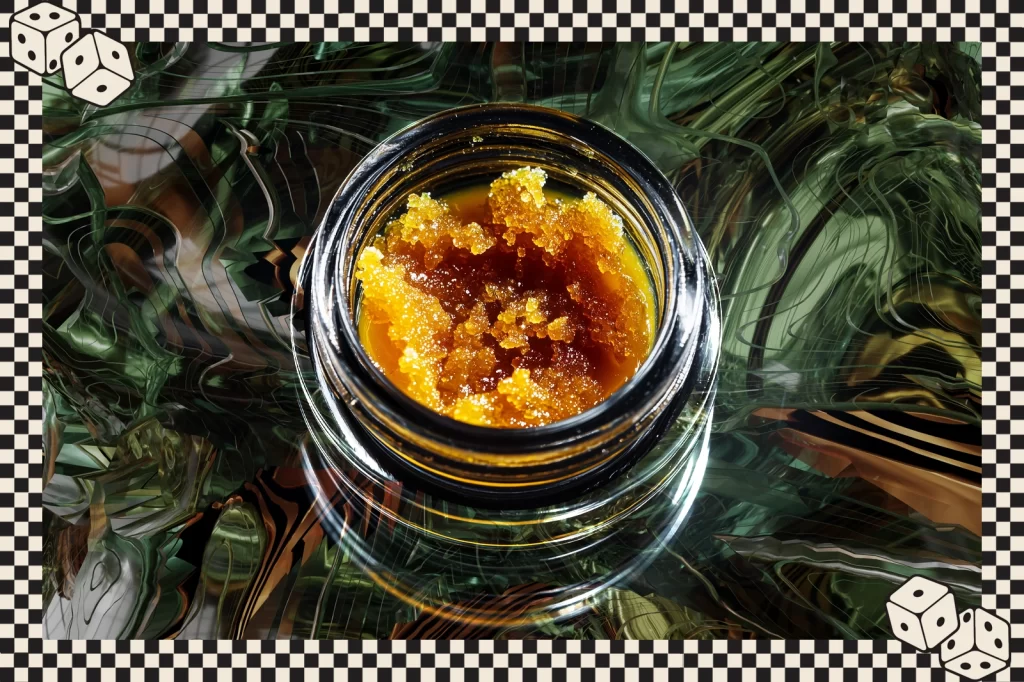
Distillate occupies the opposite end of the spectrum from rosin. Rather than preserving the plant’s full profile, distillate production is specifically designed to isolate individual cannabinoids at the highest possible purity.
The process begins with crude cannabis oil, which is then decarboxylated to convert inactive acid forms like THCa into active THC, and run through a multi-stage distillation process that separates compounds by their boiling points.
Research on wiped-film short path molecular distillation confirms that this is deliberately a two-stage process, removing terpenes first before isolating cannabinoids, which explains why native terpenes do not survive into the final distillate.
During this process, terpenes are effectively removed. Distillate vs live resin vs rosin comes down most sharply to this single point: distillate strips away nearly everything except the target cannabinoid, resulting in an odorless, flavorless oil that can reach 80-95% cannabinoid purity.
That purity gives distillate a very predictable, consistent potency, which is part of why it became the dominant oil for mass-market vape cartridges and edibles.
Terpenes and flavoring can be added back after distillation, either as cannabis-derived terpenes (CDT) or botanically-derived terpenes (BDT). CDT re-additions can partially recreate a strain’s profile, but they are never quite the same as a native, preserved terpene content.
To summarize:
| Category | Live Resin | Rosin | Distillate |
| Starting Material | Fresh cannabis that is flash-frozen immediately after harvest | Flower, kief, or bubble hash (live rosin uses fresh-frozen bubble hash) | Starts from crude cannabis oil |
| Extraction Method | Hydrocarbon extraction (propane) at very low temperatures | Heat and pressure only (solventless) | Multi-stage distillation separating compounds by boiling point |
| Solvents Used | Yes, but fully purged after extraction | No solvents at all | Yes during initial processing and refinement |
| Terpene Profile | Very terpene-rich, closely mirrors the living plant | Full-spectrum, very clean flavor; live rosin rivals live resin | Terpenes removed, resulting in minimal natural flavor |
| Flavor & Aroma | Smells/tastes closest to the original strain | Clean, natural flavor with strong effects | Odorless and flavorless unless terpenes are added back |
| Potency / Cost / Use | Flavor-focused concentrate | Most expensive due to low yield and labor | 80–95% cannabinoid purity, common in vape carts and edibles |
Potency numbers on a label tell an incomplete story. A 90% THC distillate and a 65% THCa live resin can produce noticeably different experiences, and the terpene content is a major reason why.
When you consume live resin or live rosin, you are taking in the cannabinoids alongside the specific terpene compounds that were present in that strain at harvest.
Myrcene contributes to sedation and relaxation. Limonene tends to produce a lifted, mood-forward quality. Pinene sharpens mental clarity.
These are not marketing descriptions. They reflect documented interactions between terpenes and the body’s endocannabinoid system. Consuming a high-terpene extract from a sativa-leaning strain like a Pineapple Express or a Lemon Haze feels different from consuming the same quantity of THC as plain distillate, and the terpene profile is a significant reason for that.
Distillate, especially distillate without CDT additions, produces a more neutral high. It hits hard because the cannabinoid concentration is very high, but many experienced users describe it as flatter, less textured than what they get from a terpene-forward concentrate.
That is not inherently bad. For people who need a predictable, consistent dose without flavor variation, distillate does that job well. It is also the most stable format for infusing edibles, since the oil has no residual plant flavor that might interfere with a food product.
The live resin vs rosin vs distillate carts conversation is one of the most common in the concentrate space because vape cartridges are the most accessible delivery format.
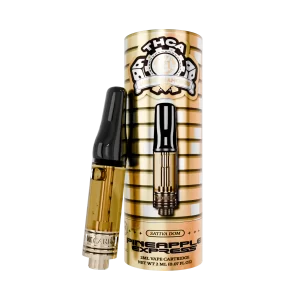
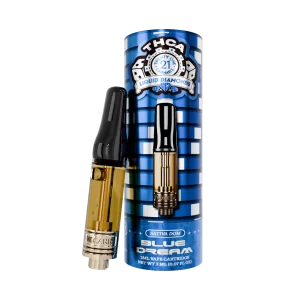
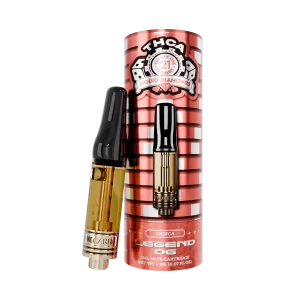
Most budget cartridges use distillate as the base oil. It is stable, flows well through hardware, and has a long shelf life. Premium carts use live resin or liquid diamond formulations that incorporate THCa with a higher terpene content.
When shopping for carts, look at whether the product specifies live resin, liquid diamonds, or distillate as the fill. A live resin cart will list cannabis-derived terpenes as part of its composition and will usually note the strain genetics it was extracted from.
A distillate cart may simply list the cannabinoid percentage with a flavor terpene added back in. The label transparency tells you a lot about what the brand is prioritizing. If the label does not specify what type of extract is inside, that is worth noting.
The answer depends on what you are actually optimizing for. There is no universal winner across all use cases in the live resin vs distillate vs rosin comparison.
Most concentrate users end up using more than one. A live resin cart for daily vaping, distillate-based edibles for a different consumption method, and live rosin for special sessions when you want to savor every detail. That kind of range is how many experienced consumers build their routine.
Standard distillate carts have one major appeal: simplicity. Screw onto a battery, inhale, feel it work. No rituals, no setup, no learning curve. The problem is that most distillate carts on the market stop there with generic oil, re-added botanical terpenes, and very little transparency about what is actually inside.
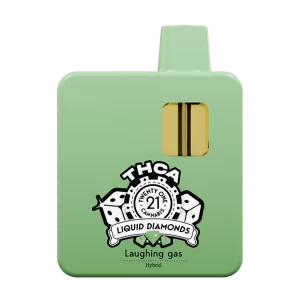
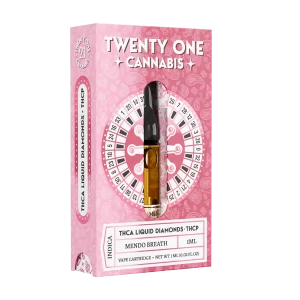
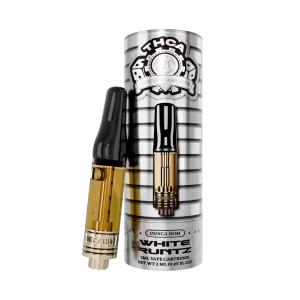
The 1ml THCa vape cartridges are built on that same straightforward format but take it several steps further. The base is a refined THCa distillate, which means you get the consistency and ease of use that distillate is known for.
What makes them different is what gets added back in: cannabis-derived terpenes for real strain character, plus THCp and Delta-8 THC to round out and amplify the effect profile in a way a single-cannabinoid distillate never could. No cutting agents, no MCT oil, no vitamin E acetate. Just clean, lab-tested oil in a 510-thread cart at a price point that makes sense.
The THCa 1ml Vape Cartridge in Berry Pie is the sativa pick for anyone who wants to stay functional and focused. It hits with sweet berry and vanilla, keeps the head clear, and delivers a steady energetic lift that suits daytime sessions or creative work. It is the kind of cart that just gets out of your way and lets you get on with things.
For evenings or wind-down sessions, the THCa 1ml Vape Cartridge in Cookie Monster is the indica counterpart. Sweet vanilla and fresh pine lead into a full-body calm that eases physical tension without leaving you completely floored. Same clean formulation, same no-fuss 510 hardware, just tuned for relaxation instead of energy.
Both carts are independently lab tested with COAs available, so you know exactly what you are getting before you take a single hit.
Premium extracts are only as good as the material they start with. Compromised starting genetics, pesticide-contaminated biomass, or poor terpene management in early processing will show up in the final product regardless of how well the extraction is executed. That is the part most concentrate brands skip over, and it is exactly where sourcing discipline separates good products from great ones.
Twenty One Cannabis sources its hemp from vetted farms in Colorado, Oregon, California, and Arizona, with on-site vetting to confirm clean, pesticide-free growing practices before any product is formulated.
Every batch ships with a Certificate of Analysis from a third-party lab, so you know exactly what you are vaping or dabbing before you open the package.
Browse our full collection of premium cannabis products and put your next session in capable hands.
Not necessarily. Distillate can reach 80-95% cannabinoid purity, which is generally higher than live resin. Live resin typically ranges from 60-80% total cannabinoids. The difference is that live resin includes a full terpene profile that shapes how the high feels, while distillate delivers raw cannabinoid potency without the entourage of supporting compounds.
Both start with fresh-frozen cannabis material and both preserve a high native terpene content. The difference is the extraction method. Live resin uses hydrocarbon solvents (propane) to pull the compounds out. Live rosin uses no solvents at all — it starts with live bubble hash made through ice water extraction and then presses that hash using heat and pressure. Live rosin is generally considered the cleaner process; live resin is more scalable and widely available.
Distillate loses its native terpenes during the high-heat distillation process. The result is a nearly flavorless, odorless oil. When flavor is present in a distillate product, it comes from terpenes added back after processing, either cannabis-derived or botanical. Live resin retains its original terpene profile from the fresh-frozen plant, which is why it tastes closer to the actual flower it was extracted from.
Yes. Many distillate cartridges have terpenes added back after the distillation process, either as cannabis-derived terpenes (CDT) or botanically-derived terpenes (BDT) from non-cannabis plants. CDT re-additions can reasonably approximate a strain’s profile, but the result is still different from a naturally preserved terpene content. Reading the product label and checking the COA will tell you whether a cart uses native or added terpenes.


Doctor of Pharmacy, Pharmaceutical Sciences University of Colorado
Co-Founder & CEO at Arvida Labs

You must be over 21 to enter.
GET NOTIFIED ABOUT ONLINE SALES AT 21 CANNABIS!